ADDRESS BY THE HON’BLE PRESIDENT OF INDIA SMT DROUPADI MURMU ON THE OCCASION OF INAUGURATION OF THE NATIONAL CONFERENCE OF CHAIRPERSONS OF PUBLIC SERVICE COMMISSION
Hyderabad : 19.12.2025
Download : Speeches  (66.08 KB)
(66.08 KB)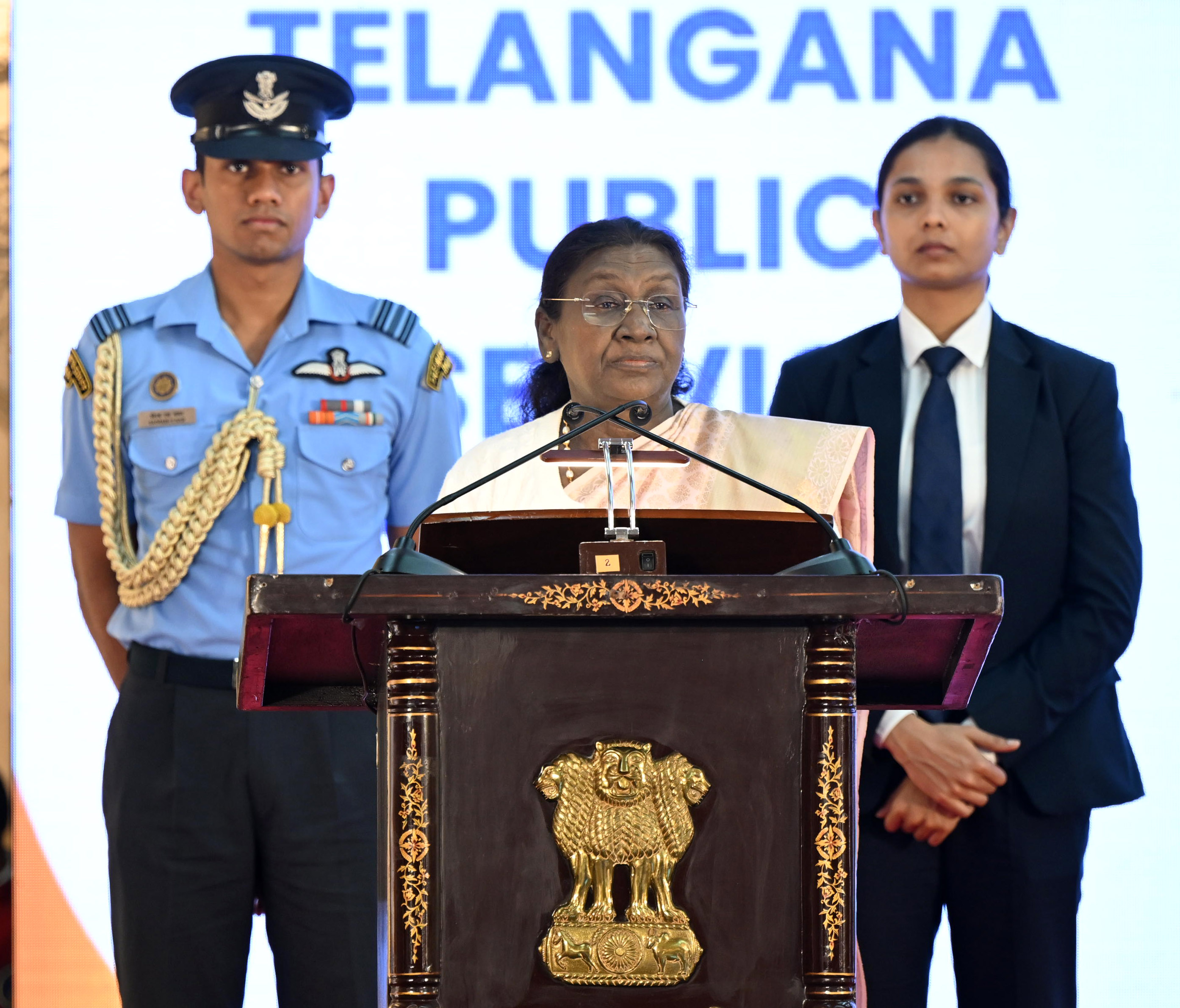
I am pleased to participate in this inaugural session of the Conference of Chairpersons of UPSC and State Public Service Commissions. The Public Service Commissions have a long tradition going back several decades. I am glad to note that the Commissions have been responding to the emerging requirements in different phases of their journeys.
Before Independence, the Central Public Service Commission was set up on October 1, 1926. Later, in accordance with the provisions of the Government of India Act 1935, Federal Public Service Commission and Provincial Public Service Commissions were established. After we became a Republic on January 26, 1950, the Union Public Service Commission and the State Public Service Commissions came into being.
I am stating these obvious facts before this gathering of Chairpersons so that all of you look at the past with a renewed sense of historicity and purpose. We must remind ourselves that during the years before our Independence, government institutions were performing with entirely different mandates.
Ladies and gentlemen,
The makers of our Constitution and nation-builders like Sardar Patel changed the expectations from the public and civil services. In the discussions about the provisions concerning the Public Service Commissions, Babasahab Dr. Bhimrao Ambedkar made foundational contribution. Our Constitution makers dedicated an entire part of the Constitution to Services and Public Service Commissions. This highlights the significance they attached to the roles and functions of the Public Service Commissions for the Union and for the States.
Our Constitutional ideals of social, economic and political justice, and equality of status and of opportunity are most pertinent to the functioning of the Public Service Commissions. The Preamble of the Constitution, the Fundamental Right of equality of opportunity in matters of public employment and the Directive Principle guiding the State to secure a social order for the promotion of welfare of the people indicate the pathways for the Public Service Commissions.
The Public Service Commissions should not only be guided by the ideal of equality of opportunity but should also try to achieve the goal of equality of outcomes. In other words, the Commissions are change-agents who promote equality and equity. I acknowledge their contribution in guiding this change.
The vision of our nation-builders has been substantially translated into reality by the efforts of the civil servants selected by the UPSC and State Public Service Commissions. I express my appreciation for all the Chairpersons and teams of UPSC and State Public Service Commissions, past and present, for their accomplishments.
India’s emergence as an important economic and political power has been made possible by the major contribution of the civil servants selected and groomed by the Public Service Commissions in the country. You have been contributing to India’s story of growth and development through the Commissions you lead.
Ladies and gentlemen,
UPSC has emerged as one of our most trusted government institutions. Its credibility for an impartial selection system and contributing to the creation of highly professional teams engaged in civil and public services is widely acknowledged. Different State Public Service Commissions have also contributed to their respective States. Thus, UPSC and State Public Service Commissions have been diligently fulfilling their Constitutional mandate.
Impartiality, continuity and stability are imparted to the process of governance by what is called the ‘permanent executive’ or the body of public servants selected by the Public Service Commissions. Integrity, sensitivity and competence of the civil servants constituting the permanent executive are of utmost importance for implementing the people-oriented policies at national and state levels.
I believe that Public Service Commissions should give highest priority to the aspect of honesty and integrity of the candidates they recruit. Honesty and integrity are paramount as well as non-negotiable. Lack of skills and competencies can be dealt with through learning interventions and several other strategies. But lack of integrity may cause grave challenges which may be impossible to overcome. Public Service Commissions need to look for instruments and tools which help understand ethical orientation of candidates.
In order of importance, the trait of sensitivity closely follows the life- value of integrity. Young people seeking employment as civil servants should have the inclination to work for the marginalised and the vulnerable. Our civil servants should be particularly sensitive to the needs and aspirations of women. Gender-sensitisation should be given high priority by Public Service Commissions.
The Public Service Commissions need to anticipate the emerging challenges on the frontiers of technology, strengthening transparency and credibility, as well as developing globally comparable teams of civil servants.
Ladies and gentlemen,
I understand that this Conference will give the Chairpersons of various Public Service Commissions an opportunity to foster co- operation and share best practices. I have been told that the Conference will deliberate on issues related to technology, legal aspects and making the entire process of recruitment more effective. I hope the deliberations in the Conference will result in very useful future-oriented solutions to important issues before the Commissions.
India, as the world’s fastest growing major economy and also a nation marked by enormous diversity, needs most effective governance systems at all levels. The country is aiming to be the third largest economy in the world in the near future. We are also moving towards achieving the goal of ‘Viksit Bharat’ by 2047.
I am sure that the Public Service Commissions will continue to fulfil their responsibilities and contribute towards building a future-ready team of civil servants selected and guided by them. Such civil servants will blend conformity with innovation, stability with creativity, continuity with rapid modernisation, and caution with decisiveness.
I wish UPSC and all the State Public Service Commissions continued success in their nation-building efforts. I wish you all a very bright future.
Thank you!
Jai Hind!
Jai Bharat!